Born in a Workshop in Little Shelford
In the mid-1960s, Rupert Neve set up shop in Little Shelford, Cambridgeshire, determined to build audio equipment that sounded better than anything on the market. Transistors were new and expensive. Reliable faders didn't exist yet. None of it stopped him.
By 1968, Neve Electronics had moved to a purpose-built factory in Melbourn, Hertfordshire, and was taking orders from recording and broadcast studios across the world — each console custom, each one entirely hand-wired by Neve technicians to tolerances that production-line manufacturing could not match.
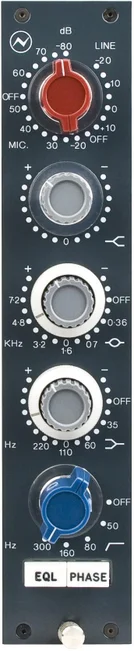
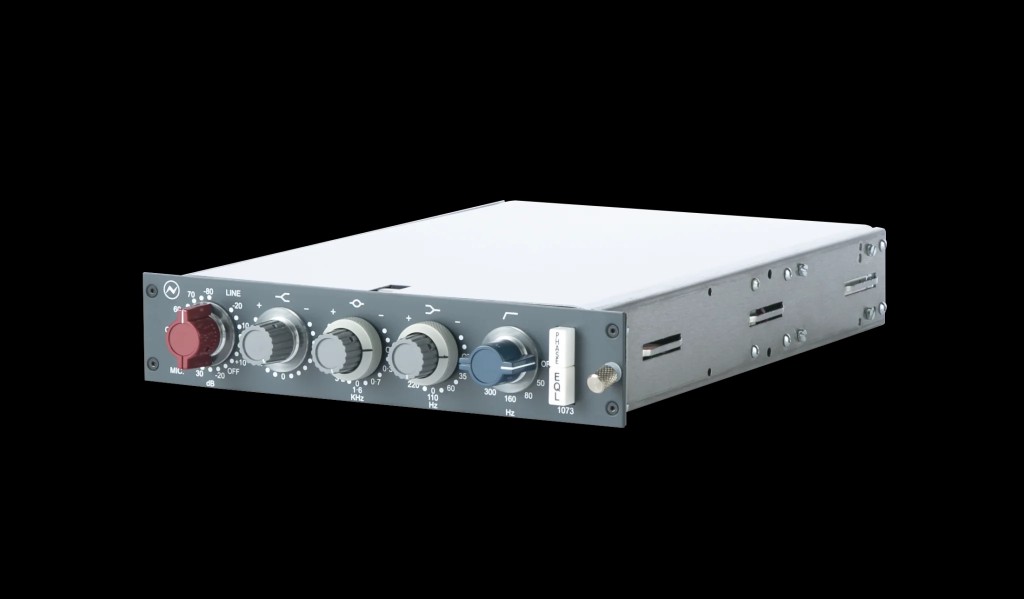
The Neve 1073 was finalized around 1970 for the Wessex A88 console. It combined a Class A microphone preamplifier with a three-band program equalizer and high-pass filter into a single module. In the specific way Neve did it — with custom Marinair transformers and discrete transistor circuitry — it became something that recording engineers would spend the next five decades trying to replicate.
The 80 Series: A Console Built Around a Module
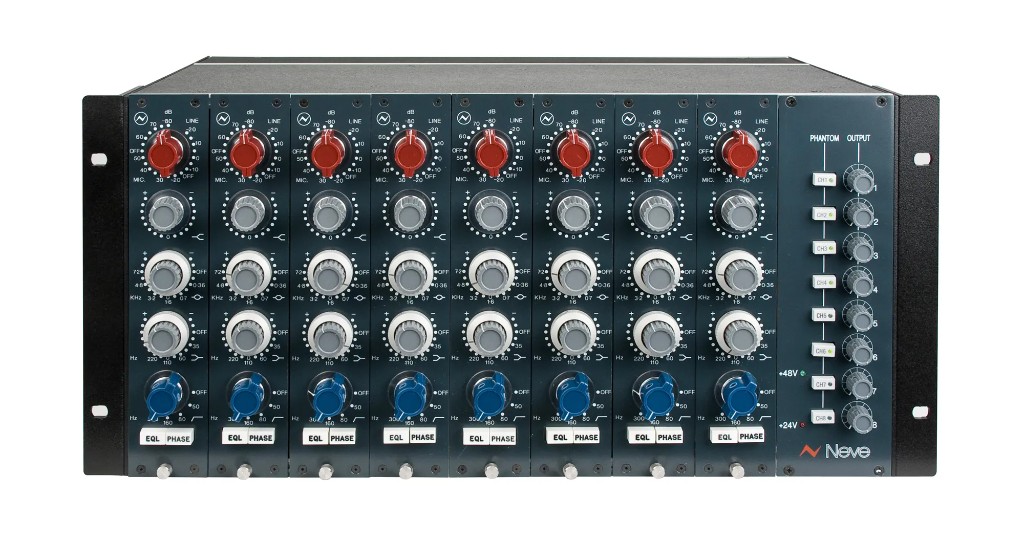
The 1073 did not exist in isolation. It was the heart of Neve's defining product line: the 80 Series mixing consoles. First introduced with the 8014 model in 1969, the 80 Series grew into the most sought-after recording consoles on earth. Each was assembled to order — custom channel counts, custom routing — and each was entirely hand-wired by Neve technicians.
The 8014 and 8034 were Class A throughout, populated primarily with 1073 preamps. As the decade progressed the line expanded. The 8028 used the 1073b variant. The 8058 and 8068, Neve's first in-line monitor consoles introduced in 1976, used the 31102 module — closely related to the 1073 with the same Marinair transformer specification. George Martin had a custom A4792 built for AIR Studios Montserrat; Dire Straits recorded Brothers in Arms on it.
In 1978, Neve introduced the 8078: the last and largest of the hand-wired 80 Series consoles — available with up to 72 channels, loaded with 31105 preamp modules sharing the same Marinair transformers as the original 1073. Neve ceased 80 Series production in 1979. A limited number were ever made.
"Studios that are lucky enough to own a Neve console of the 80 Series generally have them as the centerpiece of their room — and for good reason."
— Vintage King AudioBuilt by Jimi Hendrix in 1970, Electric Lady ran a Neve 8078 at the heart of Studio A. David Bowie recorded Scary Monsters here. AC/DC tracked Back in Black. Daft Punk returned to this console for Random Access Memories. Still operating today.
George Martin built AIR Montserrat around a custom Neve A4792 — the 8078 variant wired to his specification. Dire Straits' Brothers in Arms was recorded here. The Police, Paul McCartney, and Jimmy Buffett all tracked at this desk. Lost to Hurricane Hugo in 1989.
Criteria's Neve 8078 made it the definitive room for the mid-1970s mainstream. The Eagles' Hotel California. Eric Clapton's 461 Ocean Boulevard. The Bee Gees' run of disco-era albums. The 8078's extended high-frequency response defined the sound of that era.
The Sound: What Makes It Different
Engineers reach for the 1073 for a specific reason: color. Unlike transparent preamps designed to capture sound neutrally, the 1073 imposes itself on the signal in ways that are consistently musical. Low-end frequencies are tight and authoritative. The upper-midrange has a presence that cuts through a dense mix without harshness.
The source of this character lives in the transformers. Neve specified custom Marinair input and output transformers that introduce gentle second-harmonic saturation at higher signal levels. Combined with Class A discrete transistor circuitry — no op-amps, no integrated circuits — the 1073 has a saturation behavior that modern circuit design can approximate but has never duplicated.
The three-band EQ uses handcrafted inductors manufactured to the original unpublished specification from the Wessex A88 design. Inductor EQ produces an asymmetric curve — slightly tighter on the boost side, extending gently on the cut — which is why 1073 EQ moves rarely sound surgical even at large values.
The Records It Made
Through the 1970s, the transformer-balanced Neve preamp was the standard at the highest-level rooms in the world. The studios that ran 80 Series consoles were the rooms where the decade's most enduring records were made.
- Led Zeppelin IVIsland Studios, London · Headley Grange (Neve mobile)1971
- Exile on Main St. — The Rolling StonesOlympic Studios, London · Stargroves (Neve mobile)1972
- Dark Side of the Moon — Pink FloydAbbey Road Studios, London1973
- Rumours — Fleetwood MacRecord Plant, Sausalito1977
- Brothers in Arms — Dire StraitsAIR Studios Montserrat (Neve custom A4792)1985
- Nevermind — NirvanaSound City, Van Nuys (Neve 8028)1991
"When I walked into a room with a Neve 8078, I knew the session would sound good before I touched a single fader. The console did half the work."
Bob Ludwig — Mastering Engineer, Rolling Stones · Nirvana · U2Timeline: From Module to Icon
Official Specifications
| Circuit type | Class A, fully discrete transistor |
| Input transformers | Marinair spec (10468 mic / 31267 line) — exclusive to Neve |
| Output transformer | LO1166 — designed by Rupert Neve, 1964 |
| Construction | Hand-built and hand-wired, UK |
| Mic gain range | +20 to +80 dB in 5dB steps |
| Line gain | −10 to +20 dB in 5dB steps · 10kΩ impedance |
| EIN | < −125 dBu @ 60dB gain |
| Max output | > +26 dBu into 600Ω |
| THD | < 0.07% (50Hz–10kHz at +20dBu into 600Ω) |
| Frequency response | ±0.5 dB 20Hz–20kHz · −3dB at 40kHz |
| EQ — High shelf | ±16 dB fixed at 12 kHz |
| EQ — Mid peak/dip | ±18 dB · 360 / 700 / 1.6k / 3.2k / 4.8k / 7.2k Hz |
| EQ — Low shelf | ±16 dB · 35 / 60 / 110 / 220 Hz |
| High-pass filter | 18 dB/oct · 50 / 80 / 160 / 300 Hz |
| Input impedance options | 1.2kΩ / 300Ω (rear Hi/Lo switch) |
| Phantom power | +48V switchable |
| Dimensions (module) | 45mm W × 222mm H × 254mm D · ~2.5kg |