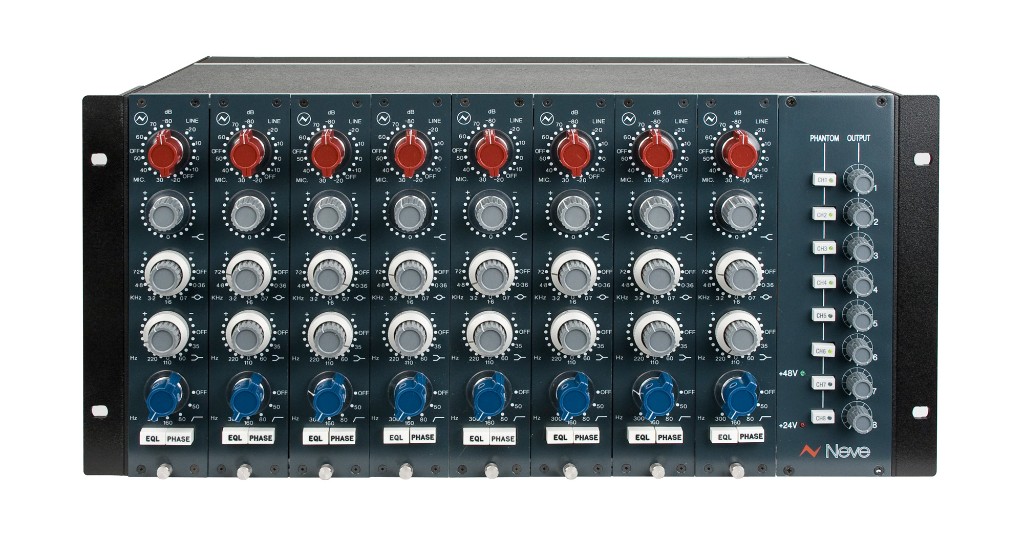
AMS Neve 1073 — the Class A preamp and EQ module that defined modern recording from 1970 to today.
Born in a Workshop in Little Shelford
In the mid-1960s, Rupert Neve set up shop in Little Shelford, Cambridgeshire, determined to build audio equipment that sounded better than anything on the market. Transistors were new. Reliable faders didn't exist. None of it stopped him.
By 1968, Neve Electronics had moved to a purpose-built factory in Melbourn, Hertfordshire. The Neve 1073 was finalized around 1970 — a Class A microphone preamplifier with a three-band program equalizer and high-pass filter in a single module. Custom Marinair transformers and discrete transistor circuitry produced a saturation character that modern circuit design has never duplicated.
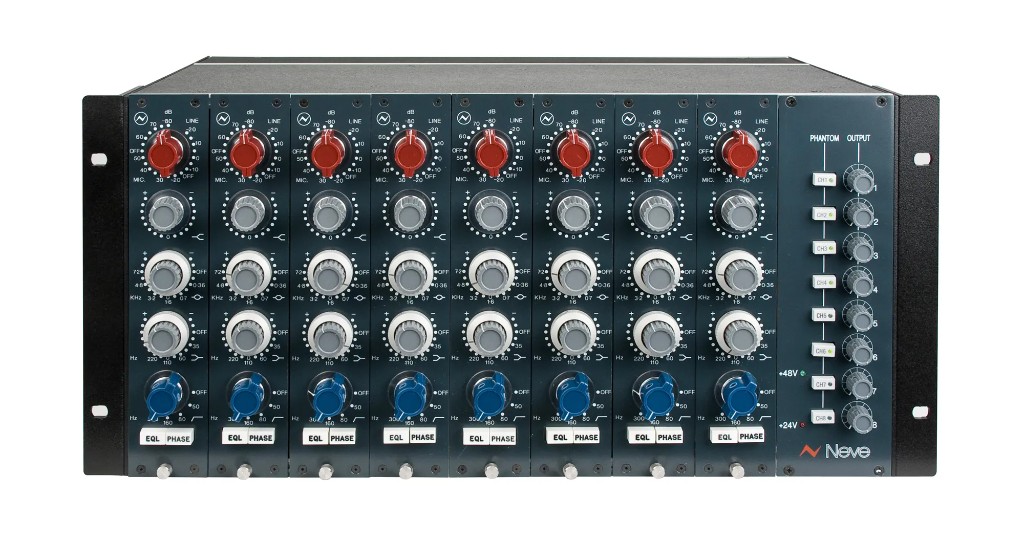
The 80 Series in the Wild
Three Rooms That Ran the Neve 8078
The 8078 was the last and largest of the hand-wired 80 Series consoles. Studios that had one built careers around it.
Built by Jimi Hendrix. Studio A's Neve 8078 has since recorded David Bowie (Scary Monsters), AC/DC (Back in Black), and Daft Punk (Random Access Memories). Still operating.
George Martin built AIR Montserrat around a custom Neve A4792. Dire Straits' Brothers in Arms, The Police, Paul McCartney. Destroyed by Hurricane Hugo, 1989.
The Eagles' Hotel California. Eric Clapton's 461 Ocean Boulevard. The Bee Gees' disco-era run. The 8078's extended high-frequency response defined the sound of an era.
The Sound: Why Engineers Still Reach for It
The 1073 imposes itself on the signal. Low-end is tight and authoritative. Upper-mid presence cuts through a dense mix without harshness. The source of this character is the Marinair input and output transformers — custom designs exclusive to Neve that introduce gentle second-harmonic saturation at higher signal levels, combined with Class A discrete transistor circuitry and hand-crafted inductor EQ coils.
No third party has ever licensed or duplicated the Marinair specification. Every 1073 sold by AMS Neve today uses the same transformer models — 10468 mic input, 31267 line input, LO1166 output — as Rupert Neve's original 1970 drawings.
The transistors Rupert chose for the 1073 circuit — the BC182 and BC184 silicon transistors — were selected after extensive experimentation with earlier BC107 and BC108 designs. The BC182/BC184 combination produced better noise figures and more predictable performance than anything that had come before. That specific transistor selection, combined with the transformer spec and the hand-wired board layout, is what the Neve engineering team — several of whom worked with Rupert in the 1960s — continues to replicate in Burnley today. AMS Neve describes it plainly: "We even use some pencil-on-paper details never published in the public domain."
"When I walked into a room with a Neve 8078, I knew the session would sound good before I touched a single fader."
Bob Ludwig — Mastering Engineer · Stones · Nirvana · U2"Neve Consoles are the Rolls-Royce of the industry... you've got to do the right thing by your business."
Sir George Martin — Record Producer · The BeatlesThe Records It Made
- Led Zeppelin IVIsland Studios / Headley Grange (Neve mobile)1971
- Exile on Main St. — The Rolling StonesOlympic Studios / Stargroves (Neve mobile)1972
- Dark Side of the Moon — Pink FloydAbbey Road Studios, London1973
- Rumours — Fleetwood MacRecord Plant, Sausalito1977
- Brothers in Arms — Dire StraitsAIR Studios Montserrat (Custom Neve)1985
- Nevermind — NirvanaSound City, Van Nuys (Neve 8028)1991
The Sound City Neve 8028 — loaded with 1084 modules, the 1073's direct sibling — was immortalized in Dave Grohl's 2013 documentary. It now resides in Grohl's personal studio in Studio City.
How "Outboard" Was Born
The word "outboard" — now standard vocabulary in every studio on earth — traces directly back to the 1073. As studios closed and 80 Series consoles were decommissioned through the late 1970s and 1980s, engineers began pulling individual 1073 modules from the frames and racking them in 19-inch cases. These portable units followed engineers from session to session, city to city. The demand for modules quickly outpaced supply; vintage 1073s became rare, then valuable, then nearly impossible to source. The modern secondary market for vintage studio gear — and the entire concept of carrying your own outboard — started with engineers who refused to give up the sound of their Neve channels.
Today authentic 1970s 1073 modules — when they surface — sell for $9,995 and above depending on provenance and console origin. Vintage King sources, inspects, and authenticates these units. Current availability on request.
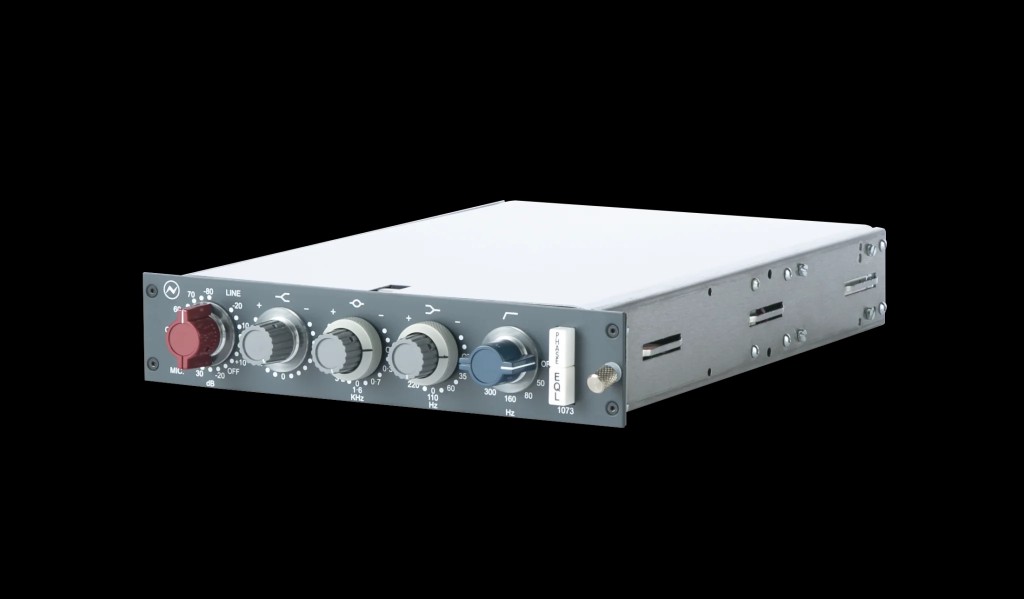
Official Specifications
| Circuit type | Class A, fully discrete transistor |
| Input transformers | Marinair spec (10468 mic / 31267 line) — exclusive to Neve |
| Output transformer | LO1166 — designed by Rupert Neve, 1964 |
| Construction | Hand-built and hand-wired, UK |
| Mic gain range | +20 to +80 dB in 5dB steps |
| Line gain | −10 to +20 dB · 10kΩ impedance |
| EIN | < −125 dBu @ 60dB gain |
| Max output | > +26 dBu into 600Ω |
| THD | < 0.07% (50Hz–10kHz @ +20dBu into 600Ω) |
| EQ — High shelf | ±16 dB fixed at 12 kHz |
| EQ — Mid peak/dip | ±18 dB · 360 / 700 / 1.6k / 3.2k / 4.8k / 7.2k Hz |
| EQ — Low shelf | ±16 dB · 35 / 60 / 110 / 220 Hz |
| High-pass filter | 18 dB/oct · 50 / 80 / 160 / 300 Hz |
| Phantom power | +48V switchable |
| Dimensions (module) | 45mm W × 222mm H × 254mm D · ~2.5kg |
Which 1073 Is Right for You?
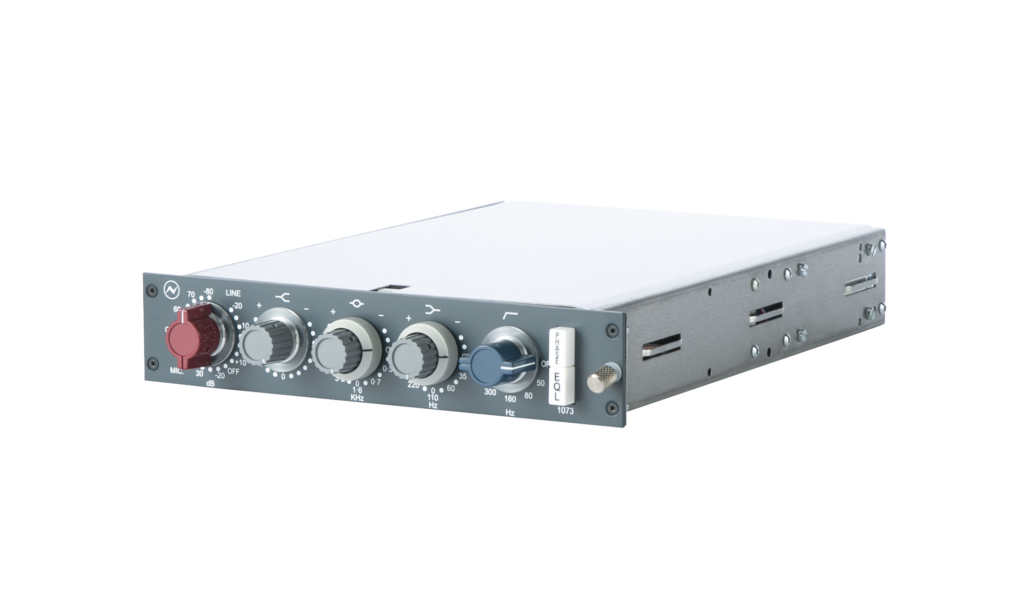
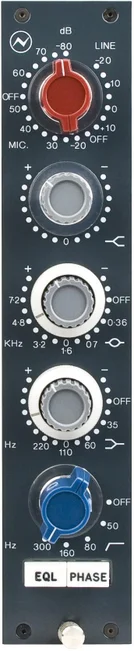
Available Formats
Frequently Asked Questions
Explore Vintage King
More From VK
Talk to a Neve Expert
We've Serviced, Sold and Restored More Neve Than Anyone
Our consultants have run sessions on vintage 80 Series desks and know this gear from both sides of the glass. Call us or browse the full inventory.