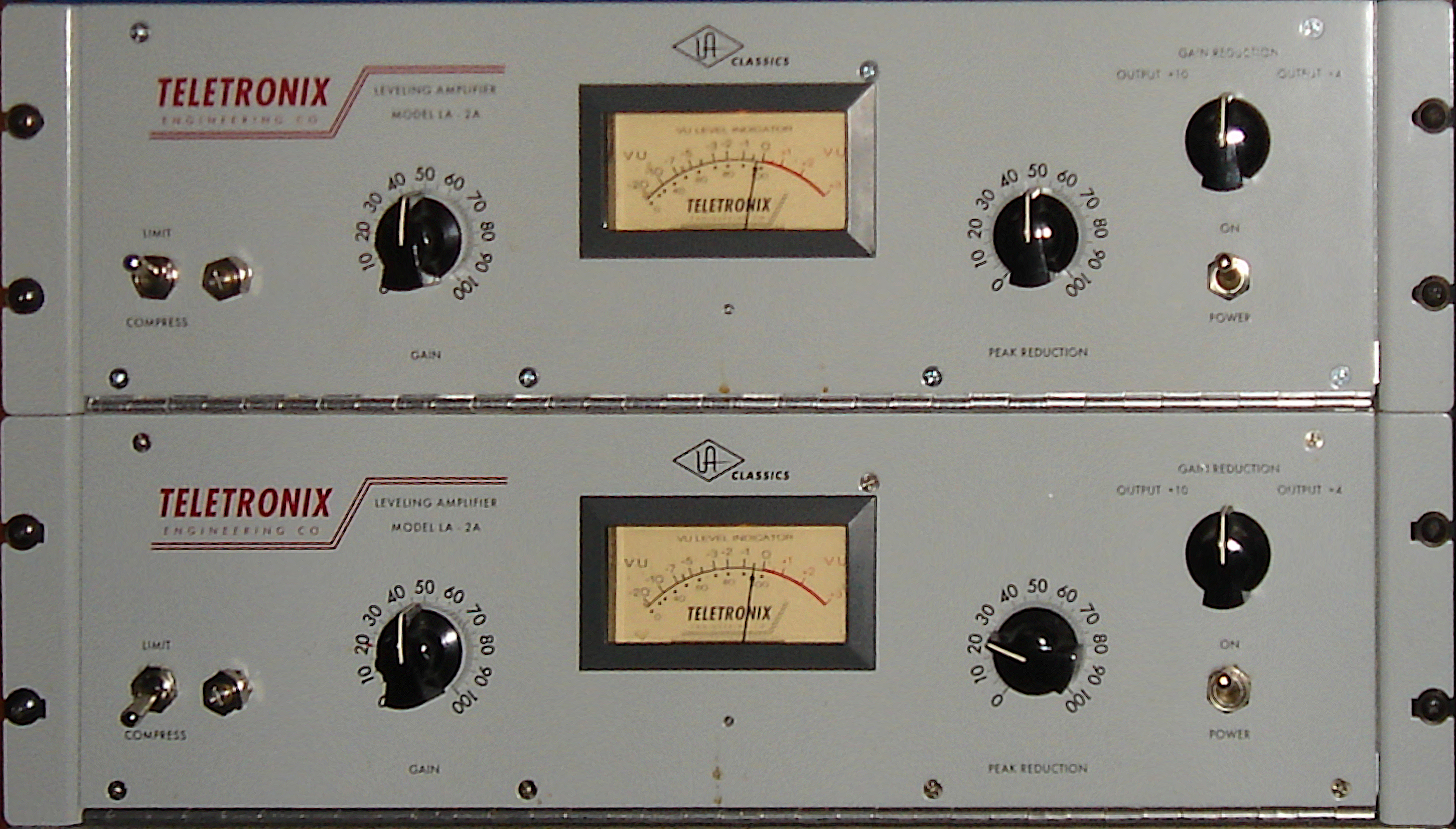
Three Controls. No Equal.
The LA-2A has three controls: Peak Reduction, Gain, and a Limit/Compress switch. There is no attack knob, no release knob, no ratio dial. The compressor decides all of that itself — based on the music. This is the entire point. Every parameter is program-dependent, driven by the T4 electro-optical cell, which responds to the nature of the signal rather than fixed settings you dialed in. The result is compression that feels less like processing and more like a performer choosing to hold back.
In sixty-plus years of compressor design, no one has fully replaced it. Dozens of very good engineers have built very good compressors inspired by the LA-2A. Most of them are worth owning. None of them are the same. The LA-2A remains the first compressor on virtually every professional vocal chain in the world — not because engineers are nostalgic, but because nothing else sounds like it on a voice.
"LA-2As warm things up. They EQ all the warmth and low mids and bass. When you put bass and drums in them they get fatter and bigger. And unless you hit them way hard and make the tubes sizzle they don't really distort."
Jim Scott — Recording Engineer (Tom Petty, Red Hot Chili Peppers, Wilco)From the Titan Missile Program to Abbey Road
James F. Lawrence II was an electrical engineer at Caltech's Jet Propulsion Laboratory in the early 1950s, working on optical sensors for the Titan Missile Program. The physics of electroluminescent panels and photoresistors — light emitted in proportion to voltage, resistance dropping in proportion to light received — gave him an idea. That same physics could control the gain of an audio circuit in a way that no other component could.
While engineering at radio station KMGM in Los Angeles, Lawrence built his first prototype to solve an everyday broadcast problem: manually riding gain for consistent levels between songs and announcements. He called it the Leveling Amplifier, and the first version, the LA-1, worked immediately. Gene Autry, the singing cowboy and one of America's most successful entertainers, was an early user. CBS and RCA adopted the next iteration, the LA-2, for their broadcast chains.
Lawrence founded Teletronix Engineering Company in Pasadena, California in 1958 to build the design properly. By 1962, the third iteration — the first revision of the LA-2 — became the LA-2A. In 1965, Lawrence sold Teletronix to Babcock Electronics. In 1967, Babcock's broadcast division was acquired by Bill Putnam's Studio Electronics (later renamed UREI), bringing the LA-2A into the world's most important recording studios. In 1999, Putnam's sons re-founded Universal Audio and reissued the LA-2A in 2000 — still in production today, twenty-five years later.
The T4 Cell — Why the LA-2A Sounds Like Nothing Else
The T4 is an electroluminescent panel (a light source whose brightness varies with applied voltage) paired with a cadmium-sulfide photoresistor (a resistor whose resistance drops as light increases). Connect them in a sealed canister and you have an optical attenuator — one that has no memory of the previous signal, but physically responds to the current one in real time.
The T4's electrical properties are inherently non-linear. The relationship between input voltage, light emission, and resistance change is not a straight line — it curves in a way that varies with frequency, level, and duration. This is why the LA-2A has no fixed attack, release, or ratio: the T4 sets all three simultaneously, and differently, for every signal passing through it.
There is no software parameter called "program-dependent optical character." You cannot dial it in. The T4 cell either is or isn't in the signal chain. This is why the LA-2A continues to exist in hardware form in 2026, and why the hardware continues to matter.
T4 electro-optical cell schematic
Every LA-2A Ever Made
Original Teletronix Engineering Co.
Painted battleship-gray faceplate, red Teletronix logo. Serial numbers 001–572 (approx.). Input transformer: UTC HA-100X. T4A opto cell. The first 10 units were hand-assembled by Lawrence himself. The Grayface is the most sought-after vintage LA-2A — rarely available and immediately bought when it surfaces.
Teletronix Division of Babcock Electronics
Brushed aluminum faceplate with red "Teletronix Div. of Babcock" logo. Lawrence sold the company in 1965. Serial numbers ~573–1000. UTC HA-100X input transformer, T4A cell. Rear panel compress/limit switch added from SN 573. Early units still used original gray faceplate from leftover stock.
Studio Electronics Corporation (Bill Putnam)
Putnam's company licensed the Teletronix patent from Babcock. Serial numbers ~1001–1200. Cosmetically similar to Babcock units — brushed aluminum with "Teletronix" logo, rear metallic sticker noting Studio Electronics manufacture. UTC HA-100X transformer, T4A cell.
United Recording Electronics Industries
Studio Electronics renamed UREI and acquired Babcock's broadcast division outright. Serial numbers ~1201–1800. Key change from SN ~1640: input transformer switched to UTC A-10, opto cell upgraded to T4B. Later units have black "UREI" logo on the brushed aluminum faceplate. T4B units are considered slightly smoother in release character than T4A.
UREI Limited Edition (~300 units)
Demand never stopped. UREI responded with approximately 300 new units — brushed aluminum, T4B cell, UTC A-10 transformer. Added a safety switch that cuts power when the front panel is opened. SN range 101–400 (approx.). These "UREI Reissues" are collectible in their own right.
Harman Electronics (~235 units)
UREI was acquired by Harman/JBL around 1985. In 1992, Harman assembled approximately 235 additional units from remaining available parts. SN range ~3000–3235. T4B cell, UTC A-10. The last vintage-parts production units.
Universal Audio Reissue (2000–Present)
Bill Putnam's sons re-established Universal Audio in 1999. Their LA-2A reissue was the second product released. Custom copy of the original UTC HA-100X transformer, T4B cell, hand-wired construction, XLR I/O on the rear panel. Compress/limit switch moved to front panel. The front panel is no longer hinged. This is the unit in production today at $4,999 — and the reference-standard hardware for any working studio.
If Vocals Are Being Tracked,
There Is an LA-2A in the Room.
Nirvana tracked the foundational sessions for Nevermind (1991) at Sound City on their Neve 8028 console. Kurt Cobain's vocals ran through an LA-2A — which is part of why the vocal takes on "Smells Like Teen Spirit," "Come as You Are," and "Lithium" hit so differently from anything recorded before them. Organic, present, controlled without sounding controlled. Engineers Mike Clink and Butch Vig both kept the LA-2A as a permanent part of their vocal toolkit.
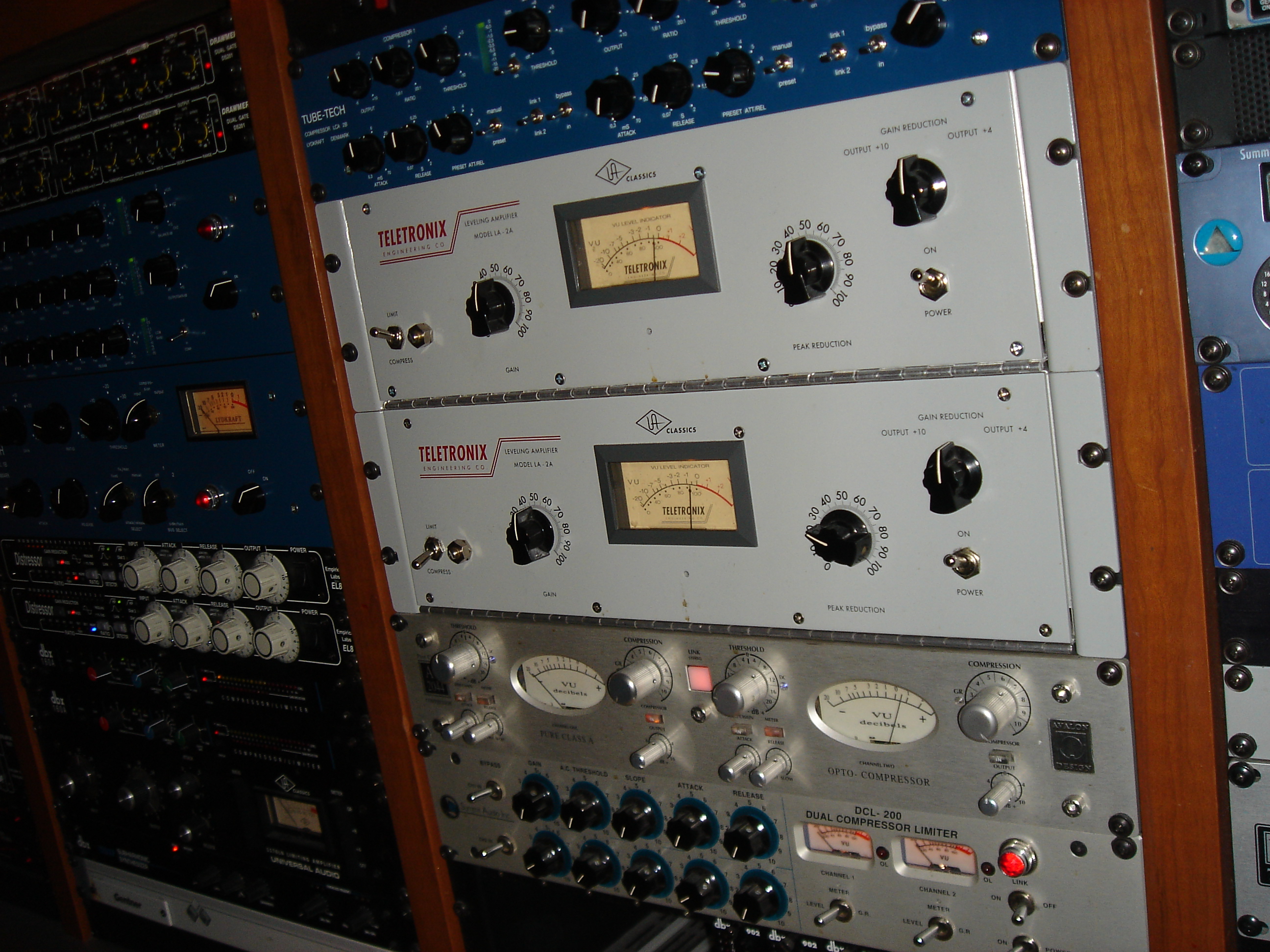
PatchWerk is one of the premier recording facilities in the American South, with a client list spanning hip-hop, R&B, and pop. Their outboard racks run multiple LA-2As as permanent fixtures — the units photographed here are working studio tools, not display pieces. Lil Wayne, T.I., Ludacris, and Usher have all recorded vocals in rooms where the LA-2A is the first compressor in the chain. That is not coincidence.
Conway has been Hollywood's go-to room for major label vocal production for over fifty years. Alanis Morissette, Red Hot Chili Peppers, Kendrick Lamar, and countless others have tracked vocals here. The studio's engineer lineage — including Jim Scott, who gave us the definitive quote on what LA-2As actually do to a signal — is as much a part of the room's reputation as the hardware. Multiple UA LA-2As live permanently in every control room.
Vocals You Have Heard Through an LA-2A
"It treats your signal so lovingly. It's inspiring to sing through psychologically. It responds especially well to the human voice in a way that inspires performance."
Bill Putnam Jr. — CEO, Universal AudioNote: Joe Chiccarelli's use on Icky Thump is one of the most referenced examples of intentional compressor distortion in modern rock. He drove the LA-2A well into clipping on Jack White's vocals, using the tube saturation as an effect. The LA-2A was never designed for this — but it sounds remarkable.
Which LA-2A Path Is Right for You?
From $34.99 plug-in to $4,999 hardware reissue. Every option at Vintage King, honest assessment of each.

Waves CLA-2A
Chris Lord-Alge's personal LA-2A presets baked in. The CLA-2A is a genuine workhorse in-box compressor — used on major label mixes daily. Not the same as hardware, but it's the fastest way to get LA-2A compression behavior into any production at any price point.
Shop Waves CLA-2A →
Acme Opticom XLA-500
500 Series optical compressor with a tube in the signal path. Compact format for home and project studios that want hardware optical compression without the full-size commitment. A genuine step up from plug-ins in terms of analog character.
Shop XLA-500 →
IGS Audio One LA
A faithful LA-2A-inspired optical design at a price point accessible to serious home studios. The classic Rev A "Grayface" version is also available as the "576 Blue Stripe." Well-regarded for its T4-inspired cell and transformer quality at this price.
Shop IGS One LA →
Acme Opticom XLA-3 MKIII
Optical limiter combining three separate compression curves into one unit. Combines LA-2A-inspired warmth with more versatile control options. Well-suited for tracking and mixing rooms that want optical compression character without restricting themselves to one compression topology.
Shop XLA-3 MKIII →
Tube-Tech CL 1B
The CL 1B has become its own modern classic — used on hit records across hip-hop, pop, and R&B every single week. Two time controllers, a dedicated gain reduction element, and a tube push-pull amplifier. More controls than the LA-2A with a similar optical warmth. For studios that want to live in the LA-2A's neighborhood with more flexibility.
Shop Tube-Tech CL 1B →
Universal Audio LA-2A
The reissue. Custom copy of the original UTC HA-100X transformer. T4B opto cell. Hand-wired. Built to original specifications by the company founded by the man who owned the Teletronix patent. This is the standard against which every other LA-2A alternative is measured. If you are building a serious room and want the real thing, this is it.
Shop UA LA-2A →LA-2A FAQ
What makes the LA-2A different from every other compressor?
The T4 electro-optical cell. The relationship between input level, light emission, and photoresistor behavior is physically non-linear and cannot be precisely replicated in software or by other hardware topologies. The LA-2A's attack, release, and ratio all change simultaneously based on the incoming signal — frequency, level, duration, and transient character all influence how the T4 responds. You are not setting parameters; the compressor is reading the music and responding to it. This is why engineers describe it as sounding "organic" or like the performer is doing it themselves: because in a very real sense, the compression curve is shaped by the music rather than imposed on it.
What is the difference between the Grayface and Silverface LA-2A?
Grayface = original Teletronix Engineering Company units, serial numbers 001–572 (approx.), 1962–1965, painted battleship-gray faceplate, red Teletronix logo, UTC HA-100X transformer, T4A cell. Silverface = all subsequent units from Babcock, Studio Electronics, and UREI, serial numbers ~573–1800, 1965–1969, brushed aluminum faceplate. Both the T4A and later T4B cells are excellent. The primary variable with any vintage LA-2A is the condition and service history — a well-maintained Silverface often outperforms a neglected Grayface. The Grayface commands a collector premium above its sonic premium.
What does the Limit / Compress switch actually do?
Switching from Compress to Limit changes the compression ratio. In Compress mode the ratio is approximately 3:1, providing gentle, musical gain reduction. In Limit mode the ratio increases significantly — closer to 10:1 or more — for more aggressive gain control. Both modes remain program-dependent via the T4 cell, so neither sounds "hard" in the way a high-ratio VCA compressor does. The Limit setting is useful for vocals with very wide dynamic range (live recordings, aggressive singers) or for bass guitar where you need more control over peaks.
Is the Universal Audio reissue the same as a vintage original?
Sonically, very close. The UA unit uses a custom copy of the original UTC HA-100X input transformer and the T4B opto cell — the same spec as the best-condition Silverface UREI units. The vast majority of blind listening tests between a well-maintained vintage unit and the UA reissue show no consistent preference. The advantages of the UA reissue over a vintage original are practical: consistent manufacturing quality, no aging components, modern XLR connections, safety features, and a warranty. The advantages of a vintage original are primarily collector/historical value and the possibility of finding a T4A cell unit in the Grayface/early Silverface range — which some engineers prefer for its slightly different release character.
What is the LA-2A best used for?
Lead vocals. That is the canonical answer, and it is correct. The LA-2A's program-dependent character is almost uniquely suited to the human voice — it rides the dynamics of a performance in a way that preserves the singer's expression while eliminating the level peaks that would otherwise require constant manual gain riding. Beyond vocals: bass guitar (classic application — fatter, warmer, more even), acoustic guitar, piano (adds presence and focus), room microphones, and as a gentle parallel compressor on drum buses. It works particularly poorly on transient-heavy drum overhead or bus applications where a fast, defined attack is needed — that is the 1176's job.
Why does the LA-2A only have three controls?
Because the T4 cell handles everything the other controls would set. Attack, release, and ratio are all determined by the physics of the electro-optical circuit — they are not parameters, they are properties. Peak Reduction sets how hard the circuit drives the T4 (and therefore how much compression occurs). Gain is makeup gain after the compression. The Limit/Compress switch gives you two different compression curves. That is genuinely all that is needed, because the T4 adapts to the rest. Adding more controls would mean overriding the circuit's natural character — which is exactly what engineers are trying to avoid.
Continue Exploring
Fairchild 660/670 — The Holy Grail of Compression
The most imitated compressor ever built. Fewer than 1,000 stereo units made. Every version available at VK.
Read the Guide →Neve 1073 — The Definitive Guide
How the 1073 mic preamp became the most cloned circuit in recording history. Three iconic studios, full specs, every version.
Read the Guide →Talk to a VK Expert
Not sure which LA-2A path makes sense for your room? Our consultants have owned and heard every version discussed here.
Meet the Team →Ready to Put an LA-2A on Your Vocals?
From plug-ins to vintage originals, our team knows every version of the LA-2A on the market. We can help you find the right unit for your room, your budget, and the sound you are after.