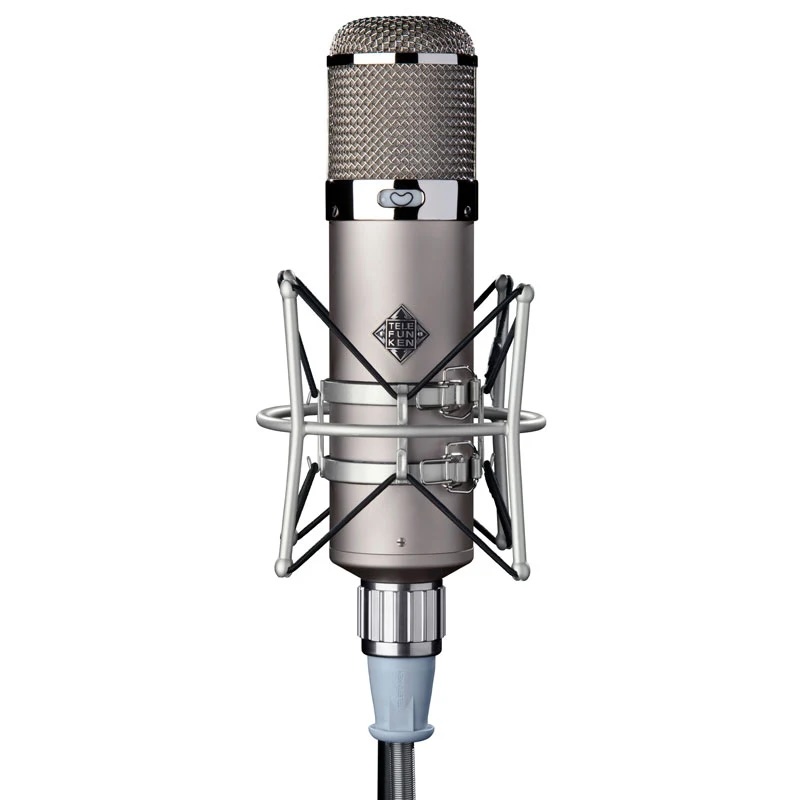
The First. The Last. The Only.
The Neumann U 47 was the first microphone produced by Georg Neumann GmbH in post-war Berlin. It debuted at the Berlin Radio Show in 1947 — the year encoded in its model number — though production delays pushed manufacture to 1949. In the years that followed, it became the industry standard vocal microphone, not because Neumann marketed it that way, but because engineers in studios across the world reached for it first and never stopped.
Frank Sinatra nicknamed it "Telly" — short for Telefunken, which distributed the microphone under a licensing arrangement. He maintained a consistent distance of about one foot from the capsule to create his signature intimate, close-in sound, and he refused to record without it. Capitol Studios built sessions around his relationship with the U 47. The Beatles used U 47s and U 48s from their first recording at Abbey Road in 1962. Rudy Van Gelder received the second U 47 to arrive in the United States, and it contributed to the sound of hundreds of Blue Note Records masterpieces.
Production ended in 1963 — not a business decision, but a physics problem. The VF14 tube that gave the U 47 its character was out of stock. No equivalent was ever manufactured. The microphones that exist today are the only ones that will ever exist. That is why a working, properly capsulled U 47 commands $20,000 or more, and why the waiting list at Vintage King for a vintage original is always active.
"The U 47, in my opinion, is the number one vocal mic of choice if I only had one to choose from. Not to mention they're outstanding for one, two and three mic drum recording techniques and on nearly any instrument."
Mike Nehra — Co-Founder, Vintage King AudioWhat Makes the U 47 Sound Like the U 47
The VF14 Tube
A pentode in a steel housing, made only by Telefunken in Berlin and Ulm. Of the 27,548 VF14 tubes produced between 1946 and 1958, approximately one third passed Neumann's stringent noise and performance tests. Those received a white "M" stamp — mikrofon — and about 6,700 of them went into U 47 and U 48 units. No equivalent tube was ever manufactured before or after. When Neumann's final stock ran out in 1963, the U 47 died with it.
The M7 Capsule
Originally designed in 1932 for the CMV 3 bottle microphone. Early U 47s used PVC diaphragms at 12 microns thick with evaporated gold, mounted on brass backplates with 90 precision-drilled holes per side. By 1960, PVC was replaced by Mylar in the K47/K49 capsule. The M7 design is still manufactured today by Microtech Gefell — and it remains the reference capsule that every large-diaphragm condenser is benchmarked against.
The Head Grille and Proximity Effect
The special wire-mesh construction of the U 47 grille was not merely protective — it contributed measurably to the microphone's tone and enhanced the proximity effect low-bass boost when a singer worked close to the capsule. Sinatra's one-foot distance was precisely calibrated to use this effect without overwhelming it. The grille was available in chrome (studio) and matte (TV and film broadcast) finishes.
The Custom-Wound Transformer
The output transformer changed twice during the U 47's production life. Early units used one design; the BV-08B transformer replaced it around serial number 4800. The transformer change also coincided with the capsule upgrade to K47/K49. Units are sometimes designated "U 47a" to distinguish the later capsule/transformer combination — though Neumann was inconsistent with this designation and it is not a reliable indicator.
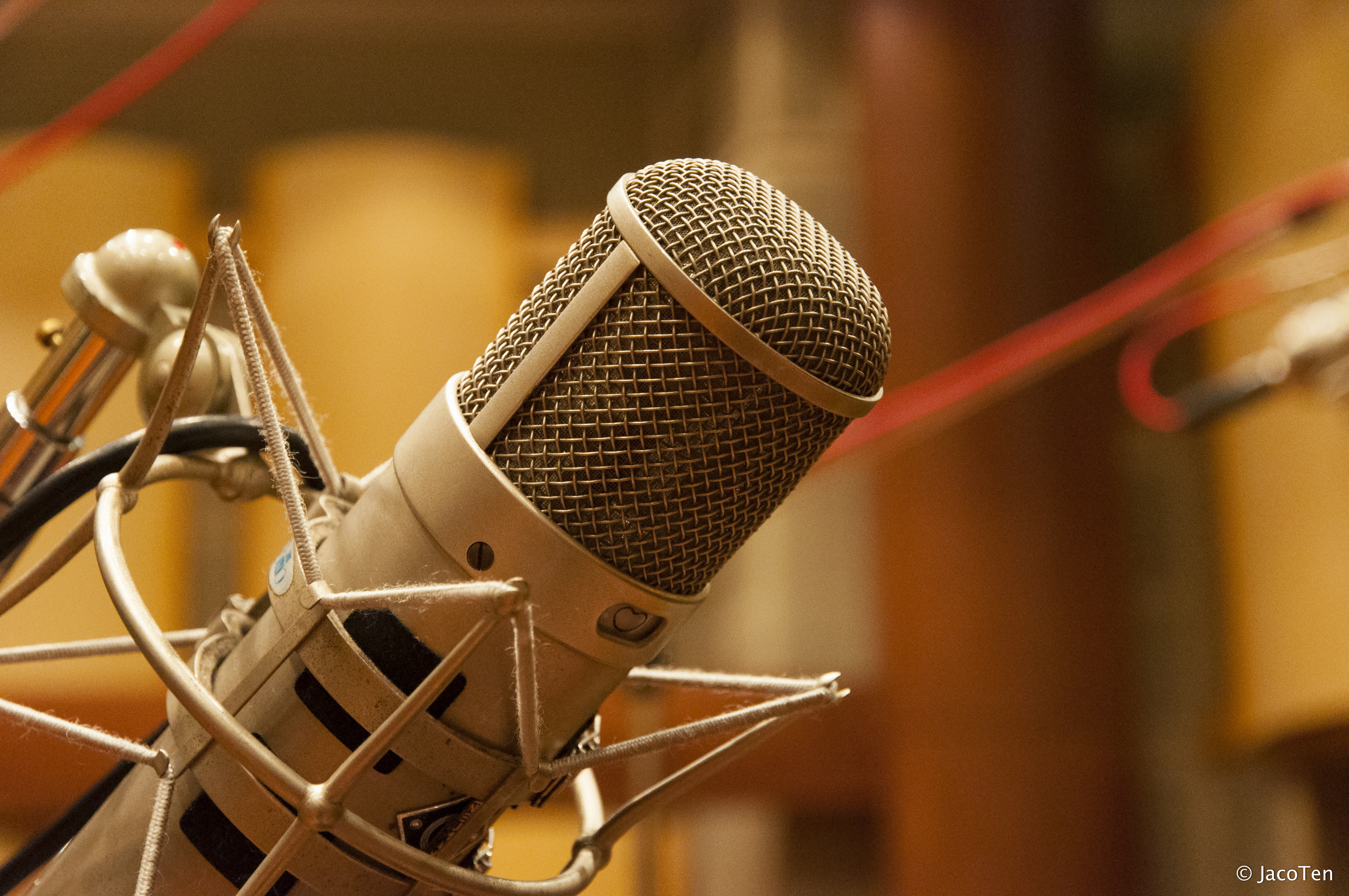
U 47 internal components — the VF14 tube and capsule assembly
Every U 47 Variant, in Order
Long Body — Original U 47
Brass body (later aluminum), 240mm long, 60mm diameter. M7 capsule with PVC diaphragms, evaporated gold. Original transformer. Available in chrome (studio) or matte (TV/film) grille finish. Large badge on earliest ~300 units: chrome diamond with Neumann logo and serial number. Replaced by the "small badge" — a metal diamond with black lacquer — on subsequent units. Approximately 3,250 long-body units made through mid-1957.
U 48 — First Examples (Figure-Eight Variant)
Some U 48 examples exist from as early as 1950 with the first regular production from 1957. Cardioid and figure-eight patterns — the "8" indicates polar pattern, not the year. Approximately 800 U 48s were produced total. George Martin specifically sent Abbey Road's U 47s back to Neumann in Berlin for figure-eight modification, creating the hybrid "U 47/48" designation used at the studio.
Short Body
Smaller components allowed the body to shorten by approximately 1.5 inches (200mm long, 60mm diameter) and the transformer to be mounted horizontally. The U 48 appears only in short-body format. All head grille and capsule assemblies (KK47) from a U 47 can be fitted to a U 48 body, making all three polar patterns (cardioid, omni, figure-eight) possible with the complete U 48 plus a spare KK47 assembly.
U 47a — Mylar Capsule (K47/K49) + BV-08B Transformer
Replacement material Mylar (polyester) was introduced for the diaphragm, replacing the aging-prone PVC. The new K47/K49 capsule used a single backplate and held the diaphragm in tension with 12 screws in a brass mounting ring — a design still made today by Microtech Gefell. The BV-08B transformer replaced the earlier design. Microphones with the new capsule were often designated "U 47a," though inconsistently.
Production Ends — VF14 Stock Exhausted
Neumann placed their third and final VF14 tube order in 1958. When that stock ran out in 1963, production of the U 47 and U 48 ceased permanently. No equivalent replacement tube was manufactured by Telefunken or anyone else. The U 47's successor was the U 67, which used the M7-derived capsule with a new EF86 tube. But the U 67 — excellent as it is — never replaced the U 47 in the esteem of engineers who had worked with both.
Three Studios.
Every Voice That Mattered.
Frank Sinatra built his late-career vocal legacy here. His U 47 — "Telly" — was the constant. Songs for Swingin' Lovers (1956), Come Fly With Me (1958), Nice 'N' Easy (1960), Sinatra at the Sands (1966). Dean Martin. Nat King Cole. Ella Fitzgerald. The Capitol sound of the 1950s and 60s is largely the U 47's sound — warm, present, intimate, with a low-end presence that placed the voice unmistakably in the room.
The Beatles recorded their first EMI session on September 6, 1962, with U 47s and U 48s on vocals. George Martin's U 48 in figure-eight mode let him record two singers facing each other — a technique that defined the sound of early Beatles harmonies. By Revolver (1966), Geoff Emerick began using unconventional close-miking techniques with the U 47, placing it far closer to Lennon's voice than any previous engineer had dared. The "thicker and richer" result defined the second half of the Beatles' studio career.
Rudy Van Gelder received the second U 47 to arrive in the United States. He deployed it immediately on Blue Note Records sessions — and the heightened presence and detail it brought to acoustic jazz instruments and vocals became the defining sonic signature of the Blue Note catalogue. Miles Davis's trumpet. John Coltrane's tenor. Art Blakey's cymbals. The immediacy and three-dimensionality of those recordings owes a direct debt to the U 47 pointed at the source.
Voices Captured Through a U 47
"At the studio, we have a bunch of great vocal mic options, but the one that goes up first 95% of the time is our U 47. It works best across the broadest range of vocals for what we do. It sounds the most natural, musical, and 'biggest' — which is what we tend to look for most often."
Ryan McGuire — President, Vintage King AudioWhich U 47 / U 48 is Right for You?
From $949 to $9,995 — every U 47-style tube microphone at Vintage King, honestly assessed.

Telefunken U47
Historically accurate BV8 transformer and classic M7 capsule from the company that made the original VF14 tube and held the distribution rights. The most faithful new-production tribute to the original at any price.

Vintage King Large Badge U47
The first-ever reproduction of the exceptionally rare "large badge" U47 — originally manufactured 1949–1950 with a bold diamond badge and GN107 transformer from Neumann's CMV-5 bottle mic. Developed with Andreas Grosser's Elektronik Service using original Neumann documentation.

Wunder Audio CM7 S
Swiss-milled brass M7 capsule, NOS Telefunken EF14 tube, and a transformer wound from original-spec vintage Mu-Metal. Smooth across the full range — engineered to handle both lows and highs without fatigue or harshness.

FLEA 47
Faithful recreation of the original BV8 transformer — exact alloy blend in the laminates. Available with F7 capsule or upgraded F47 (brass ring K47 replica). Option to spec a genuine Telefunken EF12 tube. The standard against which other U 47 reproductions are measured in professional studios.

Heiserman H47tube
Premium handmade build with a custom USA-made BV08 transformer, NOS Telefunken EF800 tube, and rare vintage capacitors and resistors. HK47 or M7 capsule. Integrated polar pattern switch. Three patterns, rigorous component selection.

Pearlman TM-47
Hand-wired point-to-point circuit with a Pearlman K47 capsule built in Southern California, paper-in-oil output capacitor, and BV8-type transformer. 6SJ7 or 6AC7 tube. Warm and rich — consistently rated among the best U 47-style mics under $5,000.

Golden Age GA-47 MK II
Hand-built in small batches with a brass body, iron grille, NOS Telefunken EF-800 tube, and replica BV8 transformer. K47 capsule blends vintage warmth with modern clarity. An honest studio tool at a serious price.

Telefunken TF47
Three polar patterns (cardioid, omni, figure-8), deep low end, and pronounced midrange from the company that distributed the original U 47. NOS Philips/Raytheon 5840W tube. Legitimate German lineage without the premium.

Warm Audio WA-47
Nine polar patterns, AMI/TAB-Funkenwerk BV8 transformer, hand-selected JJ 5751 tube from Slovakia. The entry point for U 47 character in a professional context — genuinely warm and surprising performance for under $1,000.

Neumann U 47 FET Collector's Edition
Neumann's own FET 80 circuit in K47 capsule format with a low-cut filter and -10 dB pad. More neutral, less harmonic color than the tube original. Exceptional transient response and high SPL handling — the U47-lineage choice for kick drum and loud sources.

Telefunken U48
Same VF14-lineage circuit and M7 capsule as the Telefunken U47 reissue — cardioid and figure-eight instead of cardioid and omni. The correct choice when you need to record two singers facing each other on one mic, exactly as George Martin did at Abbey Road.
FET Honorable Mentions
FLEA FLEA47 SUPERFET ($2,675) · Wunder Audio CM7 FET S ($2,450) · Heiserman H47 FET ($1,499) · United Studio Technologies UT FET 47 ($899) · Warm Audio WA-47F ($599)
Shootouts and Studio Sessions
The FLEA 47 NEXT head-to-head against a vintage Neumann original — and a look inside a historic matched pair from Vintage King.
U 47 FAQ
What is the difference between the U 47 and U 48?
The U 47 offers cardioid and omnidirectional polar patterns. The U 48 offers cardioid and figure-eight. In cardioid mode they are nearly identical in sound. The U 48 figure-eight mode has a slightly higher noise floor due to how the polarization voltage is split between the two diaphragms (52.5V each instead of the ideal 60V for cardioid), and later U 48 units with the BV-08B transformer have a 4–6 dB output loss versus U 47 equivalents. George Martin converted Abbey Road's U 47s to figure-eight specifically to record Beatles harmony vocals facing each other on one mic — those modified units were designated U 47/48.
Why did the U 47 stop being made?
The VF14 pentode tube — made only by Telefunken and used in no other microphone — was discontinued after 1958. Of the 27,548 VF14s produced between 1946 and 1958, only about one third passed Neumann's noise and performance tests and were marked for microphone use. Neumann placed three orders; the third was their last. When that stock ran out in 1963, production of the U 47 and U 48 ended permanently. Telefunken produced many other tubes in the VF family, but none were equivalent in spec. No manufacturer has ever produced a genuine VF14 equivalent.
What is the difference between the M7 and K47 capsule?
The M7 is the original dual-diaphragm capsule from 1932, used in all U 47s up to approximately serial number 4800. It uses PVC diaphragms at 12 microns thick with evaporated gold, edge-terminated around dual brass backplates with 90 precision-drilled holes per side. The PVC material tends to degrade over time — shrinking and cracking, affecting frequency response. By 1960, Mylar (polyester) replaced PVC in the K47/K49 capsule, which uses a single backplate and 12 mounting screws. Mylar does not degrade the same way. Early M7 capsules that are in excellent condition are often preferred for their upper-mid character, but well-maintained K47 capsules are their equal and more stable.
What is the long body vs. short body U 47?
Long body U 47s (approximately serial numbers 1–3250, produced until mid-1957) are 240mm long. As components shrank, the body was shortened to 200mm — the "short body." Both use the same basic circuit. The long body is often preferred by collectors and commands a premium, but sonically the two are comparable given similar capsule and transformer versions. All U 48s are short bodies. The head grille and capsule assembly (KK47) from any U 47 fits any U 48 body.
Why does the U 47 sound different from every other condenser microphone?
Three factors work together in a way that has never been fully replicated. First, the VF14 pentode tube's behavior — pentodes are less common in microphone circuits, and the VF14 specifically was selected by Neumann after rigorous noise testing from a limited population. Second, the M7/K47 capsule's large diaphragm and precise backplate geometry capture low-frequency warmth and transient detail simultaneously. Third, the custom-wound transformer and the interaction between these three components creates a mid-range presence peak and a low-frequency warmth that places voices in three-dimensional space. Engineers describe it as sounding "bigger" than the actual sound source — as though the singer is closer and more present than they physically are.
How do I get the U 47 sound on a realistic budget?
Several paths. For under $2,000: the Pearlman TM-1 and Telefunken TF47 are genuinely excellent U 47-inspired designs built with care. For $2,000–$5,000: the Pearlman TM-47 and FLEA 47 NEXT are the current studio references for U 47-character at non-vintage prices. For $10,000: the Telefunken U47 reissue is the closest new-production equivalent. For vintage originals ($20,000+): contact Vintage King's team directly — we actively source original U 47 and U 48 units and maintain a waitlist for buyers who are serious.
Continue Exploring
Teletronix LA-2A — The Voice of a Generation
The U 47 captures the voice. The LA-2A shapes it. Pair them and you have the most documented vocal chain in recording history.
Read the Guide →Neve 1073 — The Definitive Guide
After the U 47 and the LA-2A, the 1073 preamp is the next piece in the classic vocal chain. Every version, every studio that ran one.
Read the Guide →Talk to a VK Expert
Mike Nehra and Ryan McGuire both quoted on this page. Those are the people who answer the phone at Vintage King.
Meet the Team →Ready to Find Your U 47?
From K47-inspired condensers to the Telefunken reissue and genuine vintage originals — our team has handled more U 47 transactions than any dealer in the country. We know every unit on the market and will tell you honestly what each one sounds like.